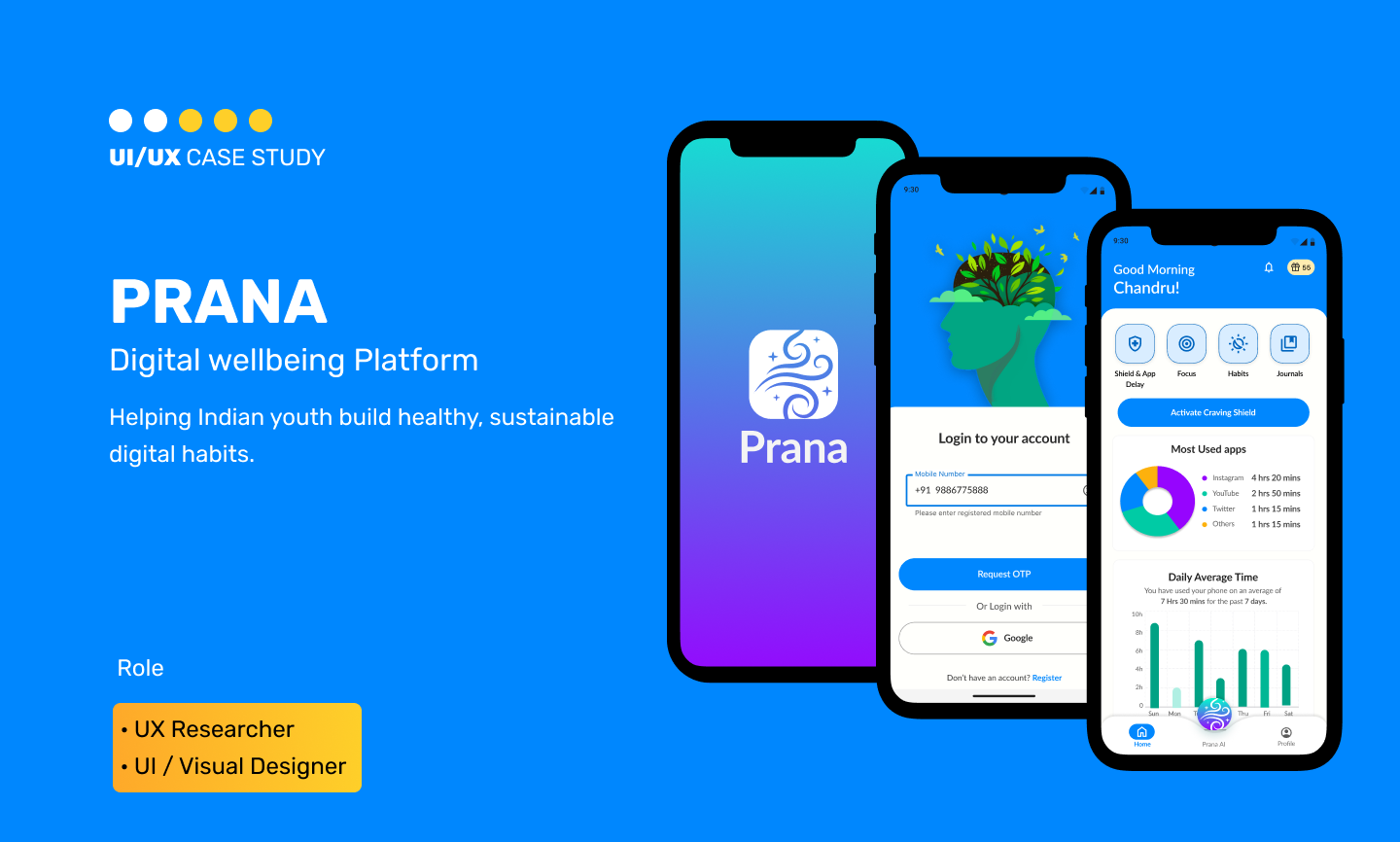
Prana — Digital Wellbeing Platform
Helping Indian youth build healthy, sustainable digital habits.
Indian youth are increasingly addicted to digital devices and instant gratification, eroding focus, sleep and mental health — existing apps only restrict, never address the underlying behaviors.
A CBT- and gamification-led platform that supports — rather than punishes — users while they rebuild healthier digital habits.
What was happening before this project.
Before: Indian youth were spending excessive time on smartphones, social media, gaming and short-form video. Existing digital-wellbeing apps mostly used timers or app blockers, which users disabled or abandoned within days.
Why it mattered: Excessive screen time was reducing focus, increasing stress and anxiety, damaging sleep, and feeding digital dependency — a growing public-health concern.
What triggered the solution: Research revealed users wanted support, not punishment — a system to understand cravings, stay motivated, and gradually build healthier habits.
The user, their context, and where the problem lives.
Mechanics — the journey, tasks and information architecture.
Download & onboard → Assess habits → Set wellbeing goals → Track screen time → Receive AI + CBT interventions → Complete mindful activities → Earn rewards & streaks → Join community challenges → Review progress
- 1.Monitor and reduce screen time
- 2.Build consistent healthy habits
- 3.Stay motivated through rewards and community support
- Forgetting digital wellbeing goals
- Ignoring screen-time reminders
- Losing motivation after a few days
- Feeling guilty instead of supported
- Lack of personalized guidance
Onboarding → Habit Assessment → Goal Selection → Dashboard → Daily Check-in → Habit Completion → Rewards → Community Challenge → Weekly Progress Review
- Returning after missed days
- Losing motivation mid-habit
- Sudden digital cravings
- Understanding long-term progress
- Reduced onboarding complexity
- Personalized habit recommendations
- Clear progress visualization
- One-tap habit check-ins
- Automated rewards & streaks
- Easy access to CBT-based interventions
Emotions, trust and the felt experience.
Fears & frustrations: Fear of losing productivity. Frustration with repeated detox failures. Confusion about where to start. Lack of accountability.
Trust issue: Users believed wellbeing apps were overly restrictive, easy to ignore, and ineffective for lasting behavioral change.
How design supported it: Soft, calming colors reduced cognitive load. Friendly, encouraging microcopy replaced judgmental language. Clean layouts kept focus simple. Positive feedback animations celebrated progress. Gamified interactions reinforced healthy behaviors.
Behaviors, workarounds, habits.
Repeated behavior: Frequent unintentional phone unlocks, automatic opening of social apps, endless scrolling, impulsive notification checking.
Habit loop: Cue: notification/boredom/stress → Craving: instant dopamine → Action: open distracting app → Reward: temporary satisfaction → Repeat.
Behavior to change: Help users pause before impulsive app use, make intentional choices, replace unhealthy behaviors with mindful activities, and sustain healthy habits over time.
New feedback loop: Daily habit tracking, progress dashboards, streaks, rewards, badges, community challenges, AI-personalized encouragement, weekly CBT-based reflections.
Proof, metrics and impact.
"This doesn't feel like another screen-time blocker — it feels like someone helping me build better habits instead of forcing me to stop."
- >20% 7-day retention, above the typical 10–20% industry average
- Average healthy habit streak of 5+ days
- High engagement in community challenges
- Strong positive feedback on CBT-based guidance
- 30-day retention
- Long-term reduction in daily screen time
- Improvement in focus and productivity over months
- Retention impact of AI-driven coaching
- Long-term effectiveness of community accountability
From ideation to design system.
- 01End-to-end design from research to design system
- 02Integrated CBT therapy frameworks into the UX flow
- 03Designed gamification system to sustain engagement
- 04Built community features for peer accountability
- 05Two rounds of usability testing and refinement
Situation · Task · Action · Result.
Indian youth are addicted to instant-gratification digital experiences, with mental health and focus collapsing.
Design a digital intervention platform that helps young users regain control and build sustainable habits.
A complete app combining CBT and gamification — beating industry retention benchmarks and giving users a felt sense of progress, not punishment.
- Primary + secondary research with 30+ young adults
- Applied CBT frameworks and gamification to the UX
- Designed personalized habit assessment and tracking
- Created community challenges and AI coaching surfaces
- Iterated through two usability-testing rounds
Before & after.
Blocker apps users disabled within days; guilt loops with no progress and no support.
A supportive, gamified habit system with AI coaching and community accountability — sustained behavior change.
Selected screens from the prototype.
What I'm taking forward.
Behavior change needs empathy, not restriction. Design that supports users — celebrating small wins and meeting cravings with intentional pauses — outperforms punitive controls.