Pathfinder — Manage Digital Life After Death
A guided dashboard for families navigating loss across fragmented digital and financial systems.
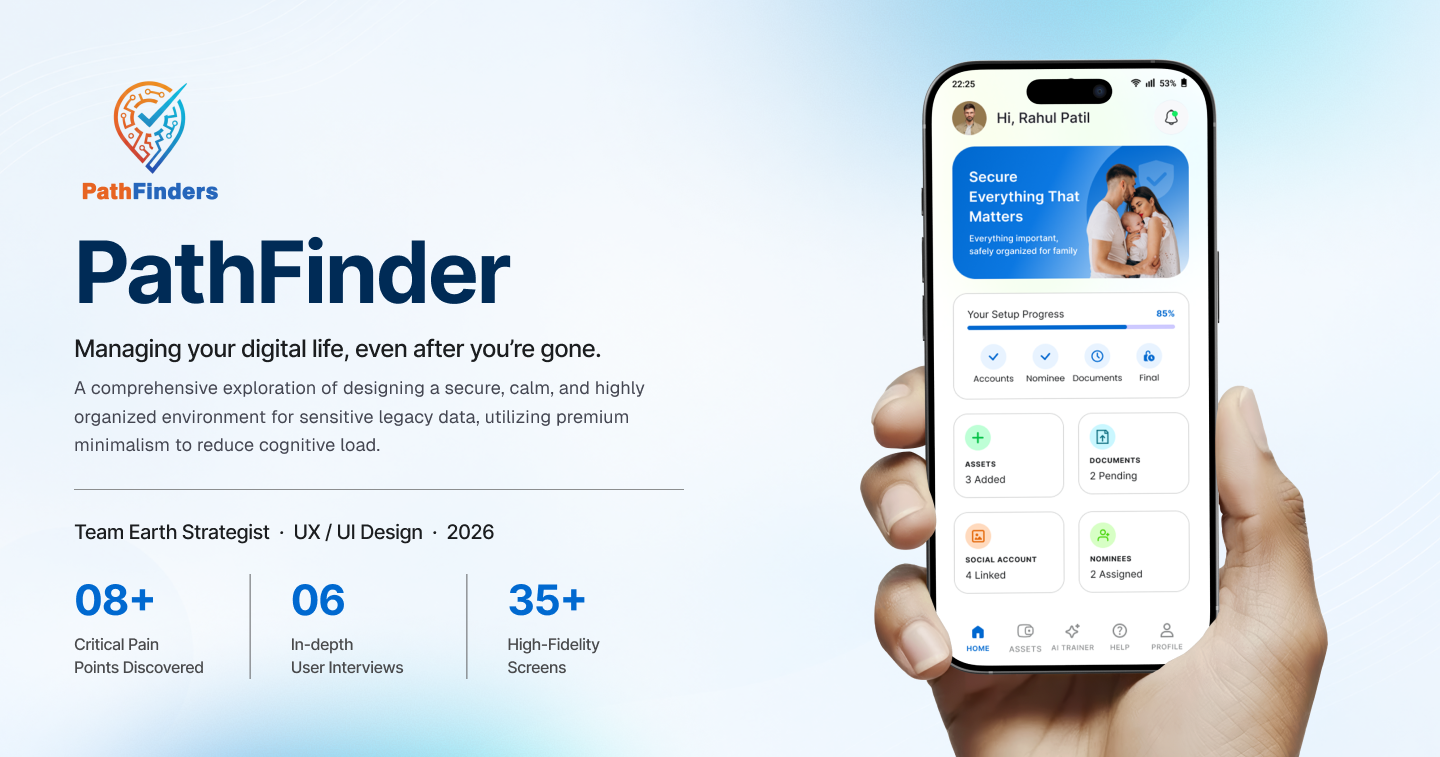
Grieving families navigate fragmented legal, financial and digital systems during emotional trauma. Existing tools store information — none guide families through the post-loss journey end-to-end.
A single guided dashboard that turns dozens of disconnected post-loss tasks into one calm, grief-aware flow.
What was happening before this project.
Before: Families had to manually manage dozens of disconnected digital accounts, financial services, subscriptions and personal data. Every institution had its own procedure and most families had no record of the deceased's digital assets.
Why it mattered: Money continued leaking through auto-debits and subscriptions. Families lost access due to OTP/2FA. Legal processes became overwhelming. Memories risked being permanently lost. Admin work compounded grief.
What triggered the solution: Research showed families facing locked smartphones, OTP failures, unknown accounts, continuing EMIs, forgotten subscriptions and repeated paperwork — all while emotionally exhausted.
The user, their context, and where the problem lives.
Mechanics — the journey, tasks and information architecture.
Loved one passes away → Family collects phone & documents → Attempts to discover accounts → Faces OTP/password barriers → Identifies liabilities → Uploads legal documents → Stops financial leaks → Transfers / closes accounts → Preserves memories → Achieves closure
- 1.Discover all digital accounts
- 2.Stop financial leakages — auto-debits, EMIs, subscriptions
- 3.Complete legal documentation with minimum effort
- Unknown accounts
- OTP dependency
- Multiple institutions
- Repeated paperwork
- Legal confusion
- Emotional overload
- Lack of guidance
Login → Enter mobile/email → Upload death certificate → Generate Digital Life Map → Review accounts → Detect financial leaks → Follow AI guidance → Complete tasks → Track progress → Closure.
- Discovering accounts
- OTP verification
- Knowing legal requirements
- Deciding what to delete
- Family disagreements
- Understanding what to do first
- One dashboard
- One document upload
- One AI guide
- One progress tracker
- One financial overview
Emotions, trust and the felt experience.
Fears & frustrations: Fear: 'I'll lose something important.' Confusion: 'What should I do first?' Frustration: 'Why does every company ask for different documents?'
Trust issue: Users feared sharing sensitive documents, losing memories, making irreversible mistakes, and choosing the wrong legal action.
How design supported it: Grief-sensitive IA, soft tone copy, role-based verification gates, pause-and-return flows and AA contrast. Memories stayed opt-in — never forced on a grieving user.
Behaviors, workarounds, habits.
Repeated behavior: Users repeatedly checked SMS, scanned email, opened bank apps, Googled legal procedures, asked relatives for passwords and visited multiple institutions.
Habit loop: Trigger: notification or financial alert → Manual search → Confusion → Delay → More financial leakage.
Behavior to change: Move from reactive searching to guided completion — users always see 'Here's your next step.'
New feedback loop: Complete task → Progress increases → Confidence increases → System recommends next action → User completes another → Movement toward closure.
Proof, metrics and impact.
"I don't even know what exists."
- User: reduced cognitive load, faster discovery, lower leakage, better legal clarity, more confidence during grief.
- Business: differentiates Pathfinder via a crisis-first, grief-aware experience; partnership opportunities with banks, insurers and legal services.
- First-task completion rate
- Time to discover all linked accounts
- Time to stop recurring payments
- Document reuse success rate
- Reduction in financial leakage
- User trust score & emotional comfort score
- NPS, SUS and overall task completion
From ideation to design system.
- 01Discover — synthesised interviews & secondary research into 7 themes via affinity mapping
- 02Benchmark — audited 6+ platforms (IQ121, DGLegacy, Everplans, Yellow, WealthX, HereAfter)
- 03Define — framed three core flows: Asset Discovery, Secure Document Vault, Guided Execution
- 04Architect — IA, journey states, verification gates around nominee vs legal-heir clarity
- 05Design — visual system, recovery dashboard, recurring-payment helper, AI guide surfaces
- 06Prototype — Figma high-fidelity across 3 end-to-end flows, planned multilingual support across 7 Indian languages
- 07Refine — iterated tone, hierarchy and accessibility; usability testing planned next
Situation · Task · Action · Result.
Grieving Indian families navigate fragmented legal, financial and digital systems with no end-to-end guide — losing time, money and memories during trauma.
Translate grief-time pain points into core UX flows: asset discovery, document verification, nominee management, leak detection, AI guidance and step-by-step recovery.
Proposed a single guided dashboard that organises fragmented post-loss tasks, surfaces silent financial leakage, and protects sensitive assets through role-based verification — keeping memories opt-in throughout.
- Synthesised 30+ user interviews, 3 expert interviews and 6 competitor audits
- Designed grief-sensitive IA, components and high-fidelity Figma prototype
- Championed accessibility — multilingual support, AA contrast, pause-and-return flows
Before & after.
Families piecing together accounts via SMS, guesswork and repeated paperwork while grieving.
One dashboard, one upload, one AI guide — a calm path through discovery, action and closure.
Selected screens from the prototype.
What I'm taking forward.
Designing for grief demands clarity, control and consent. Calm hierarchy and guided completion beat data density. Memories must always remain opt-in.