MyKinara Customer App
A self-service lending experience for India's MSME owners.
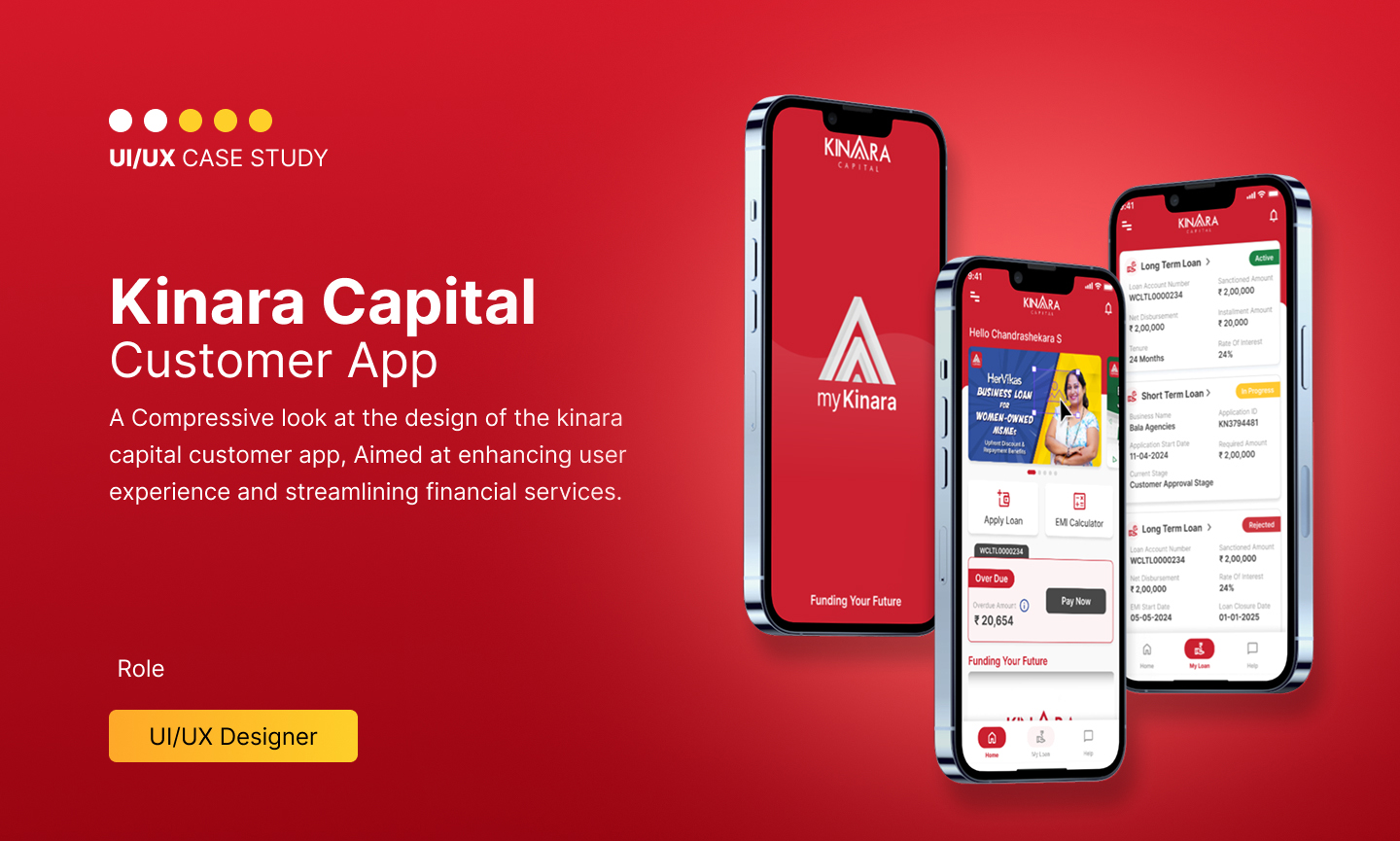
Customers couldn't independently manage their loan lifecycle, depending on support teams for every update — causing delays, confusion, and load on support.
Reduced support dependency, improved transparency, and gave MSME owners full control over their loan journey.
What was happening before this project.
Before: The existing MyKinara app was built for internal field officers. Customers had limited access to loan information and depended heavily on support and relationship managers.
Why it mattered: Without independent lifecycle management, customers experienced delays and confusion, while operational load on support teams kept growing.
What triggered the solution: Kinara Capital wanted to accelerate digital adoption and build a customer-first experience that improved transparency, self-service, and trust.
The user, their context, and where the problem lives.
Mechanics — the journey, tasks and information architecture.
Discover Loan → Apply → Track Application → Manage Loan → Make Repayments → Raise Support Requests → Download Documents
- 1.Check loan status — quick visibility of active loans, applications and schedules.
- 2.Make EMI or overdue payments with a simple, trustworthy flow.
- 3.Raise and track support requests without calling.
- Information scattered across multiple channels
- Heavy dependency on customer support
- Difficult loan terminology
- Poor repayment visibility
- No ticket tracking
Login → Home Dashboard → Loan Details → Repayment Schedule → Payment → Confirmation. Support: Home → Help → Raise Ticket → Track Status → Resolution.
- Understanding loan stages
- Tracking repayments
- Finding documents
- Knowing next actions
- Loan visibility
- Repayment journeys
- Service request process
- Navigation hierarchy
- Financial terminology
Emotions, trust and the felt experience.
Fears & frustrations: Fear of missing EMI payments and penalties. Confusion about status, outstanding amount and next steps. Frustration over repeated support calls for basic info.
Trust issue: Users lacked visibility into their loan lifecycle and had low confidence in digital servicing.
How design supported it: Red anchored brand consistency; green/yellow/blue signaled status. Plain-language copy replaced jargon. Clear hierarchy, large touch targets, instant feedback and real-time updates built confidence.
Behaviors, workarounds, habits.
Repeated behavior: Users repeatedly contacted support to check status, verify repayments, and request documents.
Habit loop: Trigger: EMI due date or query → Action: Call support → Reward: Get information.
Behavior to change: Shift users from support dependency to self-service loan management.
New feedback loop: Action → Instant confirmation → Status update → Trust → Continued usage. Examples: payment success, ticket status, loan updates.
Proof, metrics and impact.
"I don't want to call support just to know my payment status."
- Business: reduced support dependency, increased digital adoption, improved operational efficiency.
- User: better transparency, faster repayments, increased confidence, easier access to information.
- Long-term repayment adoption rate
- Retention and engagement metrics
- NPS improvement
- Reduction in support workload
- Feature adoption across multilingual users
From ideation to design system.
- 01Stakeholder discovery and competitor audit (Lendingkart, FlexiLoans, Indifi, NeoGrowth, BharatPe)
- 02Personas, journeys, IA & navigation structure
- 03Multilingual onboarding, home dashboard, My Loans, repayments, success/failure states
- 04Service request and ticket tracking module
- 05Reusable design system and component library
- 06Usability testing, terminology simplification, payment & support refinement
Situation · Task · Action · Result.
MyKinara was built for field officers; customers had no real self-service. Support teams absorbed every routine query.
Lead end-to-end redesign of the customer app to enable independent loan management while reducing operational load.
Customers self-serve loan tracking, repayments and support — driving a 40% reduction in support calls and 60% in-app repayment adoption.
- Stakeholder interviews and customer pain-point synthesis
- Competitor analysis and IA redesign
- Multilingual onboarding, dashboard, repayment, support and document flows
- Reusable design system rolled across product squads
- Usability testing with MSME owners across regions
Before & after.
Customers called support for every loan query, repayments happened offline, and tickets had no visibility.
Customers track loans, repay, raise and follow up on tickets and access documents — all from one transparent dashboard.
Selected screens from the prototype.
What I'm taking forward.
Designing for financial products is not just about transactions — it's about building trust, reducing anxiety, and empowering users to manage their finances independently.